
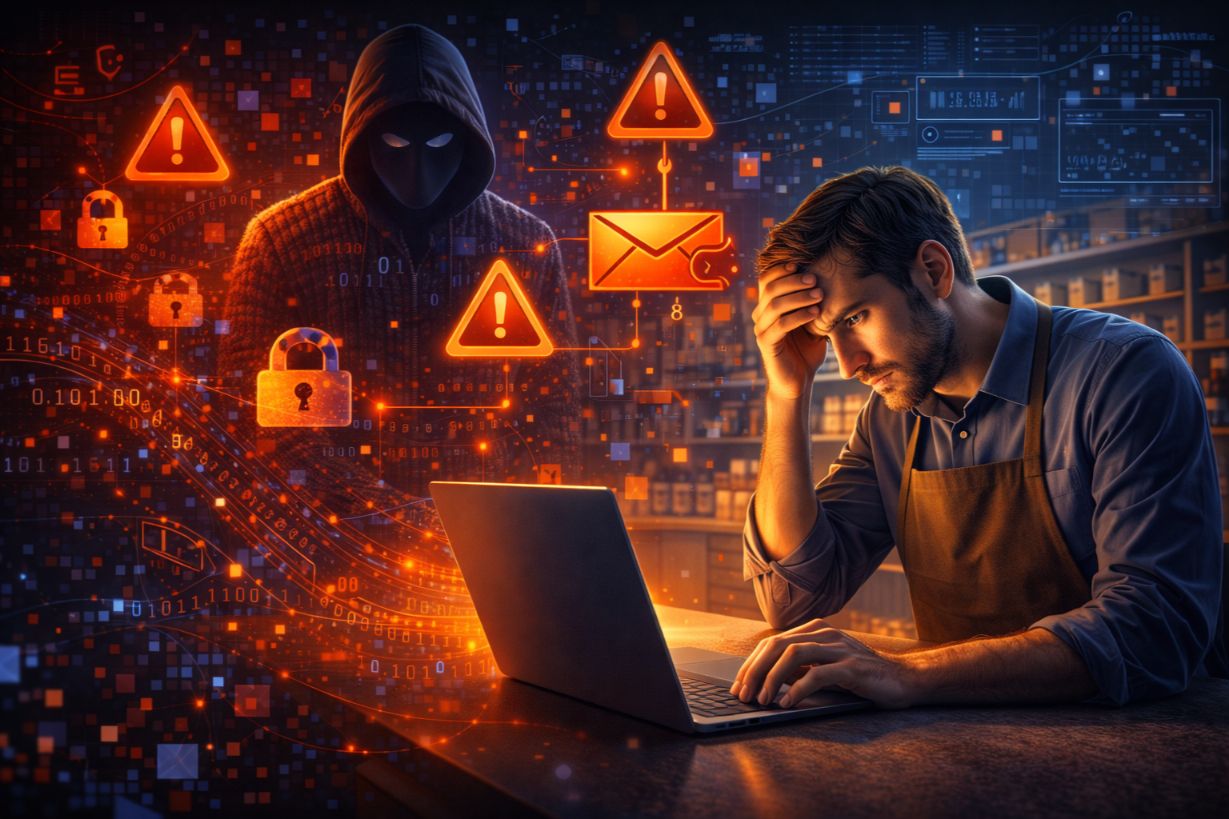
Why Small Businesses Are the New Prime Targets for Cyberattacks in 2026
Cybercriminals have shifted their focus — and small businesses are now squarely in the crosshairs.
For years, many SMBs believed hackers only targeted large enterprises with deep pockets. That assumption is no longer just outdated — it’s dangerous. Today, small business cybersecurity is one of the most critical issues facing organizations of every size.
In this article, we’ll uncover why SMBs are now the preferred targets, the most common attack methods being used, and what small businesses must do to protect themselves in an increasingly hostile digital landscape.
The Harsh Reality: SMBs Are Now the Easiest Targets
Cybercriminals operate like businesses. They look for:
- High return
- Low resistance
- Repeatable success
Small businesses fit that model perfectly.
Why Hackers Prefer SMBs:
- Weaker security defenses
- Limited IT staff or expertise
- Fewer security tools in place
- Slower detection and response times
- Higher likelihood of paying ransoms
In many cases, attackers don’t even know who they’re targeting — they simply scan the internet for vulnerabilities and strike wherever defenses are weakest.
The True Cost of a Cyberattack on a Small Business
A cyberattack isn’t just an IT problem — it’s a business survival issue.
Real Impacts SMBs Face:
- Operational downtime
- Data loss or corruption
- Financial theft or fraud
- Regulatory fines
- Reputational damage
- Customer churn
For many SMBs, a single serious breach can take months — or years — to recover from. Some never do.
The Most Common Cybersecurity Threats Facing SMBs
Understanding today’s threat landscape is the first step toward protection.
1. Phishing & Social Engineering Attacks
Phishing remains the #1 entry point for cybercriminals.
These attacks trick employees into:
- Clicking malicious links
- Downloading infected attachments
- Sharing credentials
Modern phishing emails are highly convincing, often impersonating vendors, executives, or even internal departments.
Why SMBs Are Vulnerable:
- Limited security training
- High employee trust
- Fewer email security controls
2. Ransomware Attacks
Ransomware encrypts business data and demands payment for its release.
For SMBs, ransomware is devastating because:
- Data access is critical to operations
- Downtime directly impacts revenue
- Recovery resources are limited
Attackers know small businesses are more likely to pay to restore operations quickly.
3. Endpoint & Device Exploits
Every laptop, desktop, and mobile device is a potential entry point.
Unpatched systems, outdated software, or unsecured devices allow attackers to:
- Install malware
- Steal credentials
- Move laterally across networks
Remote work has dramatically increased this risk.
4. Weak Passwords & Credential Theft
Many SMB breaches occur without any hacking at all.
Stolen credentials from:
- Data breaches
- Phishing campaigns
- Password reuse
allow attackers to log in as legitimate users — often going undetected for weeks or months.
5. Cloud Security Misconfigurations
As SMBs adopt cloud platforms, misconfigured settings have become a major risk.
Common issues include:
- Publicly exposed storage
- Excessive user permissions
- No multi-factor authentication
Cloud platforms are secure — but only when configured correctly.
Why Traditional Antivirus Is No Longer Enough
Many SMBs still rely on basic antivirus software and assume they’re protected.
Unfortunately, modern attacks:
- Bypass signature-based detection
- Use fileless malware
- Leverage legitimate system tools
This is why advanced threat detection and response is now essential.
What a Modern Small Business Cybersecurity Strategy Looks Like
Effective cybersecurity isn’t about one tool — it’s about layers.
1. Endpoint Detection & Response (EDR)
EDR tools:
- Monitor device behavior
- Detect suspicious activity
- Automatically isolate infected systems
This allows threats to be stopped before they spread.
2. Email Security & Phishing Protection
Advanced email security uses:
- AI-based threat detection
- Link and attachment scanning
- Impersonation protection
Combined with employee training, this dramatically reduces risk.
3. Multi-Factor Authentication (MFA)
MFA stops attackers even if credentials are stolen.
It’s one of the highest ROI security controls any SMB can deploy.
4. Continuous Monitoring & Alerting
Cyberattacks don’t happen on a schedule.
24/7 monitoring ensures:
- Faster detection
- Faster response
- Reduced damage
This is especially critical for SMBs without in-house security teams.
5. Regular Security Awareness Training
Employees are the first line of defense.
Training helps staff:
- Recognize phishing attempts
- Avoid risky behavior
- Respond correctly to incidents
Human awareness paired with technology is a powerful defense.
The Role of Managed Cybersecurity Services for SMBs
Most small businesses cannot afford:
- A full security operations center
- Dedicated cybersecurity staff
- Round-the-clock monitoring
This is why managed cybersecurity services have become the preferred model.
MSPs Provide:
- Enterprise-grade security tools
- Continuous threat monitoring
- Incident response expertise
- Compliance support
All at a predictable monthly cost.
Compliance, Insurance & Cybersecurity Are Now Connected
Cybersecurity is no longer optional from a compliance standpoint.
Regulations and cyber insurance providers increasingly require:
- MFA
- Endpoint protection
- Incident response plans
- Regular risk assessments
Poor security can now mean denied insurance claims or regulatory penalties.
Real-World Example: SMB Cyberattack Fallout
A 25-employee manufacturing company experiences a phishing attack:
- Employee clicks malicious link
- Credentials are stolen
- Ransomware deploys overnight
Without proper backups or monitoring:
- Operations halt for days
- Customers are delayed
- Data recovery costs escalate
With layered security in place, the attack could have been detected — or stopped entirely.
Cybersecurity Is a Business Investment, Not an IT Expense
The most successful SMBs view cybersecurity as:
- Risk management
- Business continuity
- Customer trust protection
Not just an IT checkbox.
SMBs Can No Longer Afford to Be Reactive
Cyber threats are growing faster, smarter, and more aggressive — and SMBs are now the primary targets.
The good news? With the right strategy, tools, and partners, small businesses can achieve enterprise-level protection without enterprise-level cost.
Proactive cybersecurity isn’t just safer — it’s smarter.
Concerned about your business’s cybersecurity posture?
Schedule a security assessment to identify risks before attackers do.