
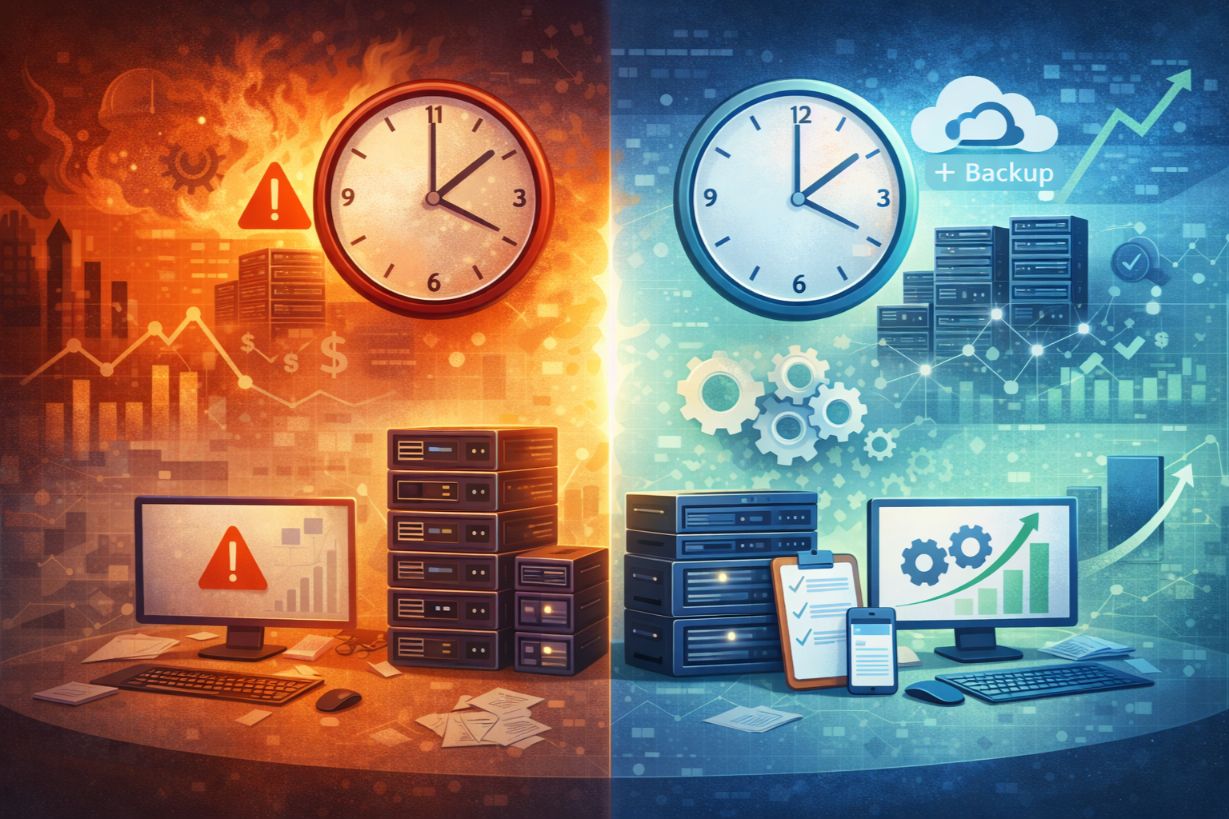
How Much Downtime Can Your SMB Really Afford? A Business Continuity Reality Check
Downtime isn’t just an IT problem — it’s a business risk.
When systems go down, SMBs face:
- Lost revenue
- Idle employees
- Missed customer commitments
- Reputational damage
Yet many businesses can’t answer a critical question:
How much downtime can we actually afford?
In this article, we’ll walk through a practical business continuity reality check to help SMBs understand their true downtime tolerance and build continuity strategies that protect operations and revenue.
Why SMBs Underestimate Downtime Risk
Downtime is often viewed as:
- Rare
- Short-lived
- Manageable
In reality, outages are becoming:
- More frequent
- More disruptive
- More expensive
Cloud reliance, cyber threats, and remote work have raised the stakes.
What Business Continuity Really Means
Business continuity isn’t just about backups.
It’s about:
- Keeping critical functions running
- Minimizing disruption
- Recovering quickly
- Communicating effectively
Continuity is operational resilience.
Understanding Downtime Cost Beyond Lost Sales
Downtime costs extend far beyond revenue loss.
Direct Costs
- Lost transactions
- SLA penalties
- Emergency IT expenses
Indirect Costs
- Employee productivity loss
- Customer dissatisfaction
- Brand damage
Long-Term Costs
- Customer churn
- Lost trust
- Competitive disadvantage
Downtime compounds over time.
RTO and RPO: The Metrics That Matter
Recovery Time Objective (RTO)
How quickly systems must be restored.
Recovery Point Objective (RPO)
How much data loss is acceptable.
These metrics define downtime tolerance and guide recovery planning.
Identifying Mission-Critical Business Functions
Not all systems are equal.
Critical functions often include:
- Customer-facing applications
- Billing and payments
- Core operations
- Communications
Continuity planning prioritizes what matters most.
Common Causes of SMB Downtime
Downtime isn’t just disasters.
Common causes include:
- Cyberattacks
- Hardware failures
- Cloud outages
- Human error
- Power or connectivity issues
Continuity plans must address all of them.
Why Backup Alone Isn’t Enough
Backups restore data — not operations.
Without continuity planning:
- Recovery may take days
- Employees may lack access
- Customers may be left waiting
Continuity bridges the gap between backup and business.
Building a Business Continuity Strategy That Fits SMBs
1. Downtime Impact Analysis
Assess:
- Cost per hour of downtime
- Impact on customers
- Regulatory consequences
Clarity drives prioritization.
2. Define Acceptable Downtime
Set realistic RTOs and RPOs based on business impact.
3. Align Technology to Tolerance
Infrastructure, backup, and recovery must support defined objectives.
4. Document and Communicate Plans
Plans must be understood — not just written.
The Role of Cloud and Modern Infrastructure
Cloud platforms support continuity through:
- Geographic redundancy
- Rapid failover
- Remote accessibility
Modern infrastructure increases resilience.
Testing Continuity Plans: The Step SMBs Skip
Untested plans often fail.
Testing:
- Validates assumptions
- Trains staff
- Reveals gaps
Testing turns theory into readiness.
How Managed BCDR Services Reduce Risk
Managed providers help SMBs:
- Design continuity strategies
- Monitor systems
- Perform testing
- Respond during incidents
This reduces pressure during crises.
Real-World Example: Downtime Reality Check
An SMB estimates downtime cost at “a few thousand dollars.”
After analysis:
- True cost exceeds $25,000 per hour
Continuity investment suddenly makes sense.
Business Continuity and Insurance Expectations
Insurers increasingly expect:
- Documented continuity plans
- Defined RTOs and RPOs
- Regular testing
Prepared businesses receive better coverage terms.
Common SMB Continuity Myths
❌ “Downtime Won’t Happen to Us”
❌ “We’ll Figure It Out During an Outage”
❌ “Continuity Is Too Expensive”
Unplanned downtime is always more expensive.
Future Trends in Business Continuity
Emerging trends include:
- Automated failover
- Continuous recovery testing
- Integrated cyber and continuity planning
Continuity is becoming proactive and intelligent.
How SMBs Can Perform a Downtime Reality Check
Step 1: Identify Critical Functions
Step 2: Calculate Downtime Cost
Step 3: Define RTO and RPO
Step 4: Assess Current Capabilities
Step 5: Close the Gaps
Awareness drives action.
Downtime Is a Business Decision
Downtime tolerance isn’t an IT choice — it’s a leadership decision.
For SMBs, effective business continuity planning:
- Protects revenue
- Preserves trust
- Enables resilience
The question isn’t if downtime will happen — it’s how prepared you’ll be when it does.
Unsure how much downtime your business can really afford?
Schedule a business continuity assessment to evaluate risk and recovery readiness